Try Terminal

Lavender Terminal · for options traders

See your whole book. Then check the math.

An options workstation built on Greeks computed the way the contracts actually behave — American exercise, discrete dividends, real borrow — and repriced continuously against the live underlying. Every number is reproducible from first principles, so you never have to take one on faith.

payment method required · no charge if you cancel before it ends · opens on a sample book, nothing to configure

check every number reproduces to within 0.1% on European options · $390 / seat / month after trial · Windows 10 / Server 2016 or later

Live, right now

This is a real surface, fitted a moment ago.

Not a screenshot. Drag it. Everything below explains how it is computed and what Terminal lets you do with it.

Drag sideways to pan across the surface.

liveYour whole volatility surface as one shape you can spin — in Terminal, with yesterday ghosted behind today.

Built by the founder of Derivix, acquired by FlexTrade.

Two decades building the analytics and execution systems professional options desks run on — now on your desktop, month-to-month, without the institutional overhead.


Modeling-correct

American exercise with optimal exercise boundaries, dividends as the discrete cash events they are, and implied borrow calibrated per expiry. Some vendors compute Greeks with Black-Scholes because it is fast — exact for European options, an approximation for the American ones you trade.

Repriced live

Your surface re-fits continuously in order of what actually trades. Your Greeks don't wait for it — every one on screen is run fresh through the American model against the live underlying the moment you read it.

Priced for your desk

Correct American pricing with sub-second repricing is normally something you rent from an institutional vendor at institutional cost. Terminal puts it on your desktop for one flat price per seat.

Q1

What's my risk right now?

Everything you hold, together — live.

One grid, every position, every dollar-Greek, marked against Lavender's own analytics and moving with the tape.
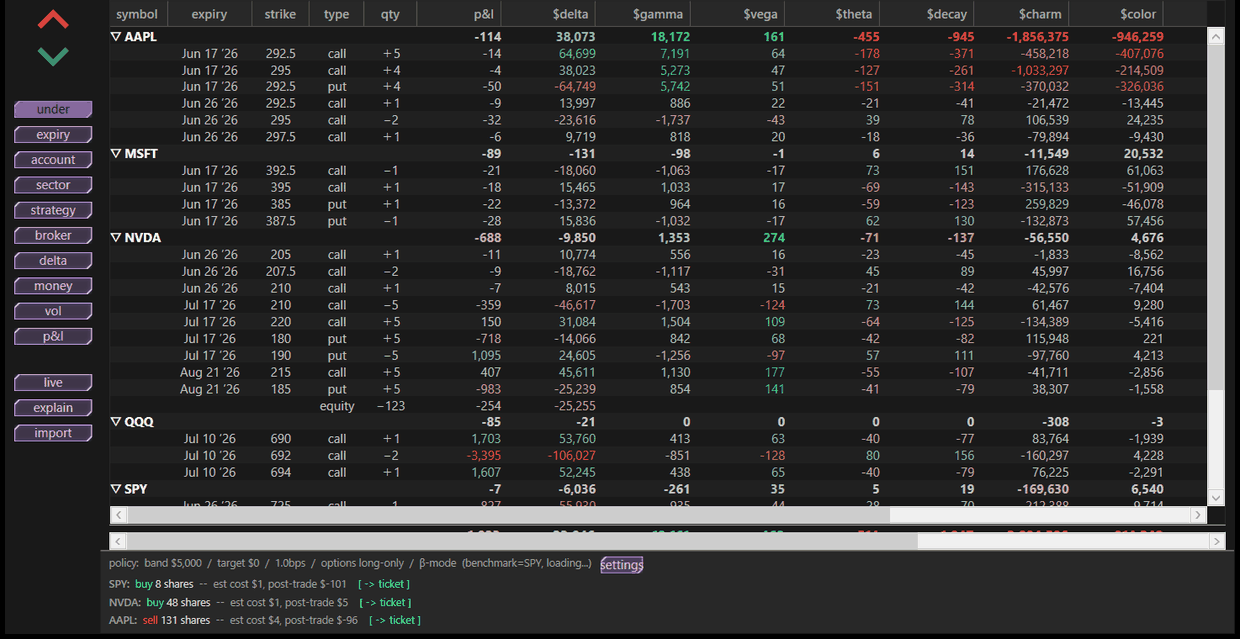
Lavender Terminal whole-book risk grid, positions grouped by underlying with dollar-Greeks and a hedge row
fig. 01Your whole book, grouped and totaled — every dollar-Greek, with the hedge ready to send.

Ten groupings, one pinned total

Group by underlying, expiry, account, sector, strategy, broker, delta, moneyness, vol or P&L — with a pinned TOTAL row and live red/green heat on $delta, $gamma, $vega, $theta, $decay, $charm and $color. Second and third-order exposure in dollars, at the book level.

View the same risk grid as it stood 1, 5 or 30 days ago — not just live.

check every figure ties to the position rows above it

It doesn't just show the exposure. It hands you the hedge.

Set a policy band and Terminal returns the trade that closes the gap — instrument, direction, size, estimated cost, and the exposure you're left holding afterwards. One click stages it on a ticket. Nothing routes, nothing trades itself.

check post-trade exposure is shown before you send

One book, across every broker

Connect Interactive Brokers, Tastytrade or Tradier and the same contract held in two accounts nets into one consolidated view. Connections are read-only — connect to monitor, never to execute.

check read-only by design; Terminal cannot place an order
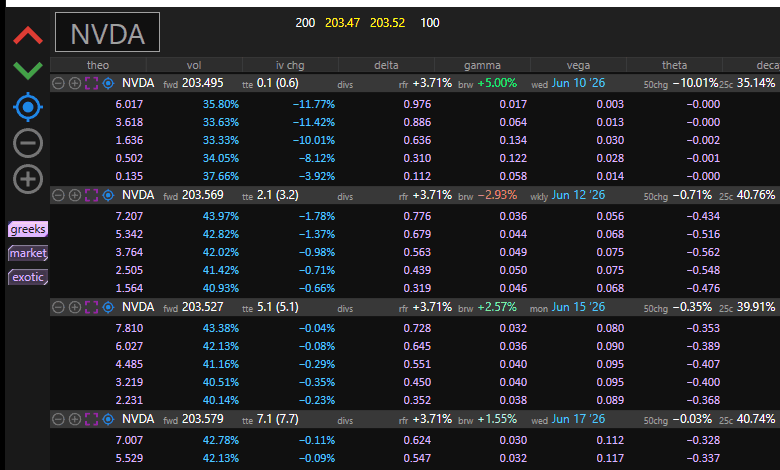
Full-chain Greeks montage for a single underlying with live latency indicator
fig. 02The full chain, every Greek, independently computed — repriced to the live underlying.

The whole chain, not just the money strikes

Every contract on the board carries independently computed IV and Greeks through third order — not interpolated from a handful of anchors, and not restricted to what's liquid. The latency of the last refresh is displayed on screen while you work.

check the refresh latency is printed in the header, not hidden

Your legs, read as strategies

Terminal classifies your positions into the structures you actually put on — verticals, calendars, iron condors, butterflies, diagonals and more, across 26 recognized strategies — so a book of loose legs reads back as the trades you meant to have.
Q2

What happens if?

Mark your whole book across a grid of what-ifs. Then drop in a crisis.

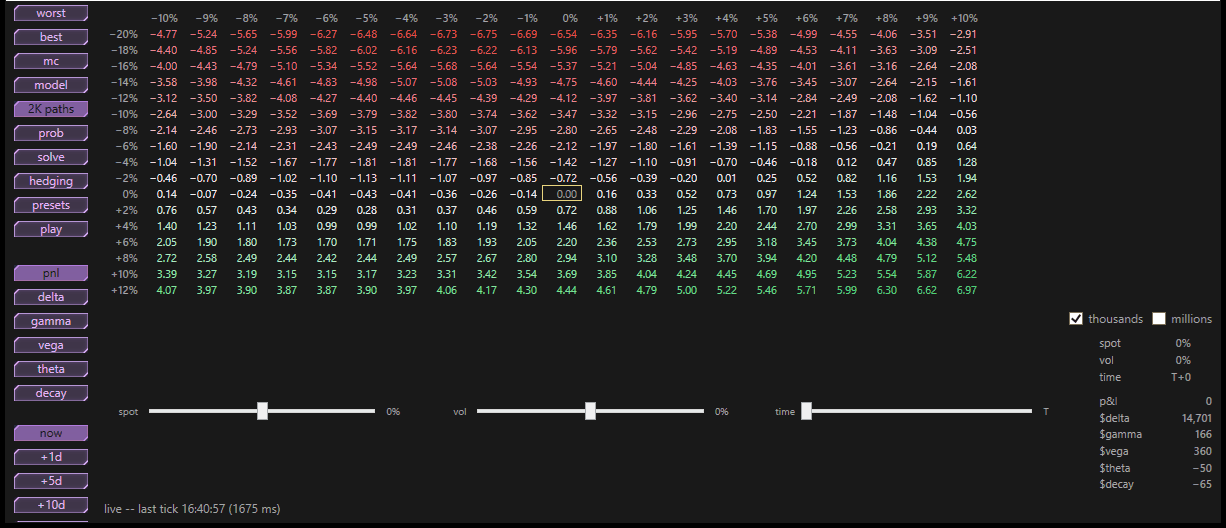
Not a sensitivity estimate off today's Greeks. Every cell is your book, repriced.

Scenario matrix showing portfolio P&L across a grid of spot and volatility shocks
fig. 03Spot against volatility, worst and best ringed — every cell a true reprice.

441 cells, every one a real reprice

Shock spot against volatility points across a 21 × 21 grid where each cell reprices the whole book through the American model. A Taylor expansion off today's Greeks is cheap and it drifts exactly when the move gets large — which is precisely when the grid matters. Roll time forward through the same grid to see the shape change.

check run the same shock in your own model and compare cell by cell

Drop in a crisis

One click applies a crisis-scale stress — Crash 2008, Covid 2020, or a VIX spike — to the book you are holding right now, so the question stops being hypothetical and starts being specific.

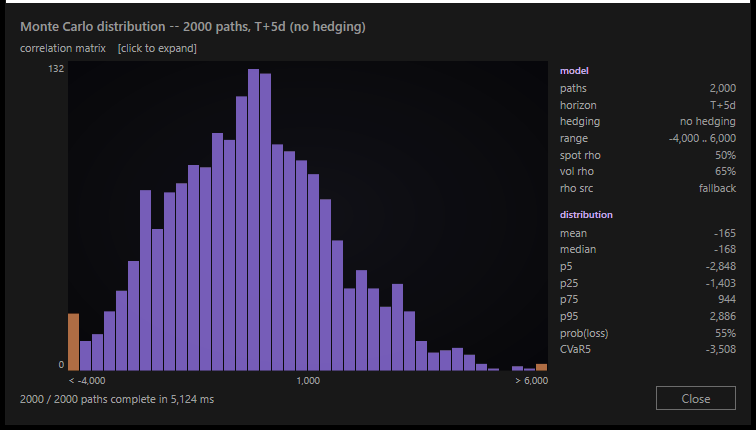
Monte Carlo distribution of portfolio outcomes with percentiles, probability of loss and CVaR
fig. 04Correlated paths, with probability of loss and tail risk reported.

Put odds on it

Monte Carlo across thousands of correlated paths — spot and volatility correlation exposed, not buried — reporting the full percentile spread, probability of loss, and CVaR at the tail. A portfolio spread across names is stressed as a portfolio, not as a pile of independent positions.

check the correlation matrix is inspectable, and path count and horizon are stated on the run

Find the move that hurts

Rather than guessing which scenario to test, invert the question: Terminal solves for the smallest move that breaks you and rings it on the grid.

Fully priced payoff curves with volatility fan and probability cones
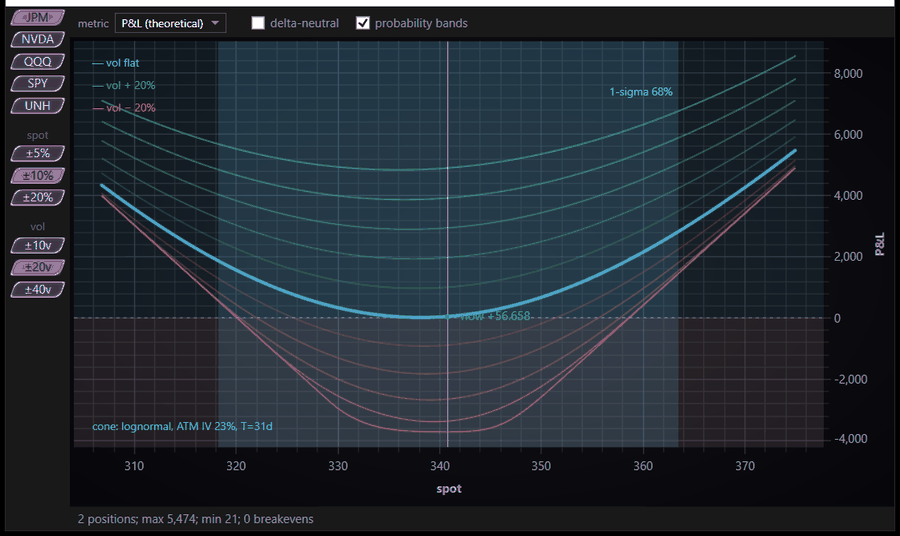
fig. 05Payoff repriced with real dividends, rates and early exercise — with one and two-sigma cones. Not hockey sticks.
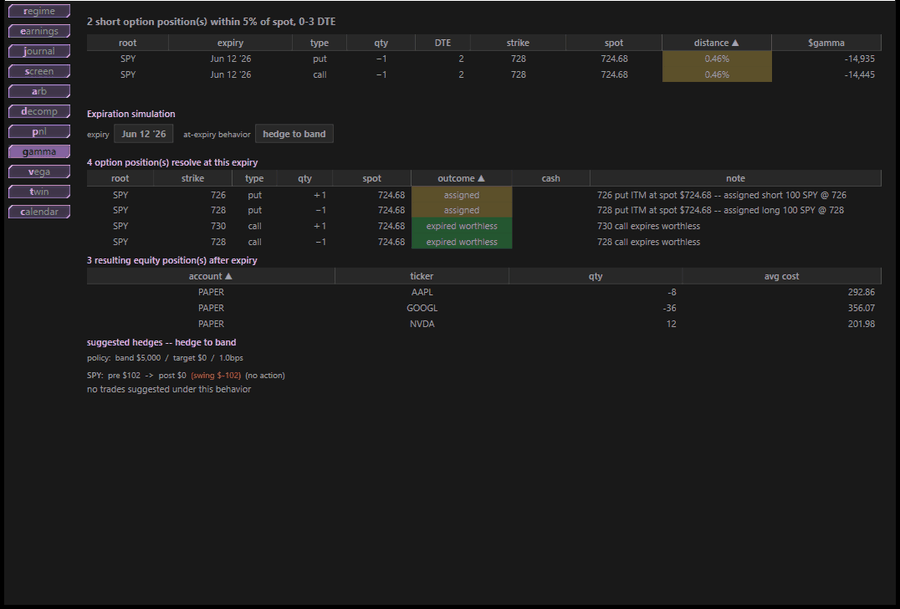
Pin risk view showing short options near strike into expiry with an expiration simulator
fig. 06Your book at Friday's four o'clock close — assignments, settlement, and the hedge to place.

Scenarios shock spot and volatility. Model any multi-leg idea on a risk-aware ticket and watch it flow through every view above before you commit — or paper-trade it and track it as a live position.

Q3

Can I trust these numbers?

Nothing here asks for faith.

The assumptions behind every number are exposed, the residual is shown rather than absorbed, and the whole engine reproduces from first principles.

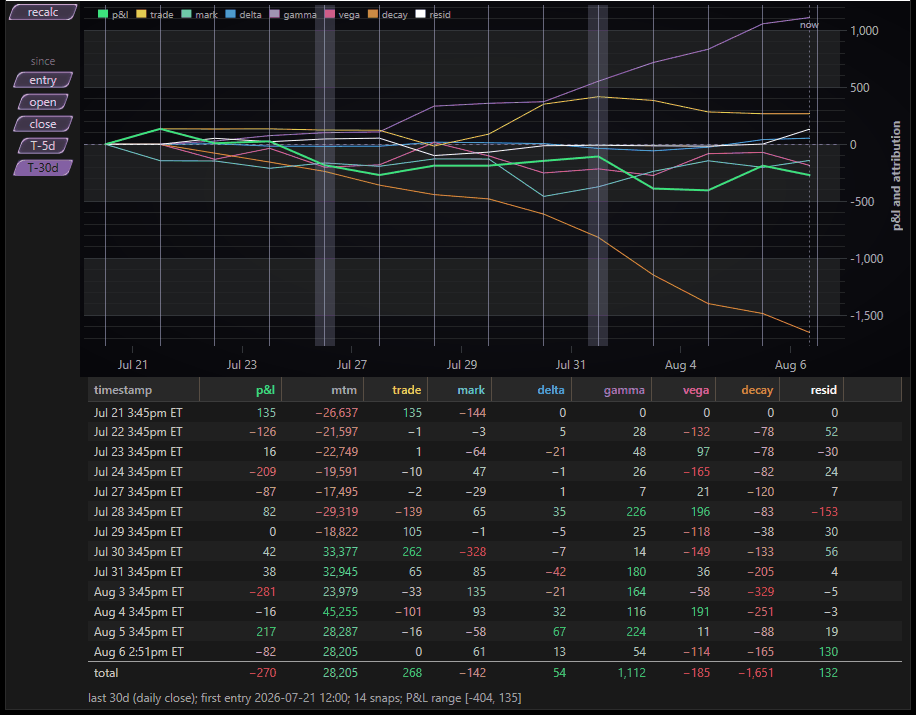
Thirty days of P&L decomposed by Greek with a residual column
fig. 0730 days of P&L, decomposed by Greek — including the residual, so you can check us.

Every dollar, explained

P&L attribution splits your day into delta, gamma, vega and time — and prints the residual in its own column. Most tools fold the unexplained remainder into the nearest bucket. If something doesn't tie out here, you will see it.

check the residual column is displayed, not absorbed

Reproduce it from first principles

Take our reference implementation into Python, R or Excel and match Lavender on European options. The inputs behind each number — dividends, forwards, borrow — are exposed on the way through, so there is nothing to take on trust.

check matches to within 0.1% on European options

The whole surface, and yesterday behind it

Spin your name's fitted volatility surface as a single shape, with T-1 ghosted behind today, alongside synchronized skew and term-structure views. A change in the shape of the surface becomes something you notice rather than something you reconstruct.

check sticky-strike and sticky-delta conventions both handled correctly · the live surface is at the top of this page

Skew and term structure charts
fig. 08Skew and term structure, in sync with the surface.

The performance story

Correct pricing is normally too slow to run live. So most tools take a shortcut.

Lavender doesn't. Two things stay fresh, on two different clocks — and the freshness is told by the volume you actually trade, not by counting names.

Two clocks

Displayed Greeks

under a second

Recomputed the instant you read them — run fresh through the American model against the live underlying, never read off a stored surface that has been aging since its last fit.

Surface re-fit

width = share of volume traded

The slow edge is the least-liquid tail — names almost nobody trades. It is never the majors, and it never gates what you are watching.

Also included

Four more views that earn their place on the screen.

Vol regime

Where current implied volatility sits against its own history, so you know whether today is genuinely rich or merely higher than yesterday.

Earnings

The event priced into the front expiry, and what the surface expects it to do — the piece most models fold into a single number.

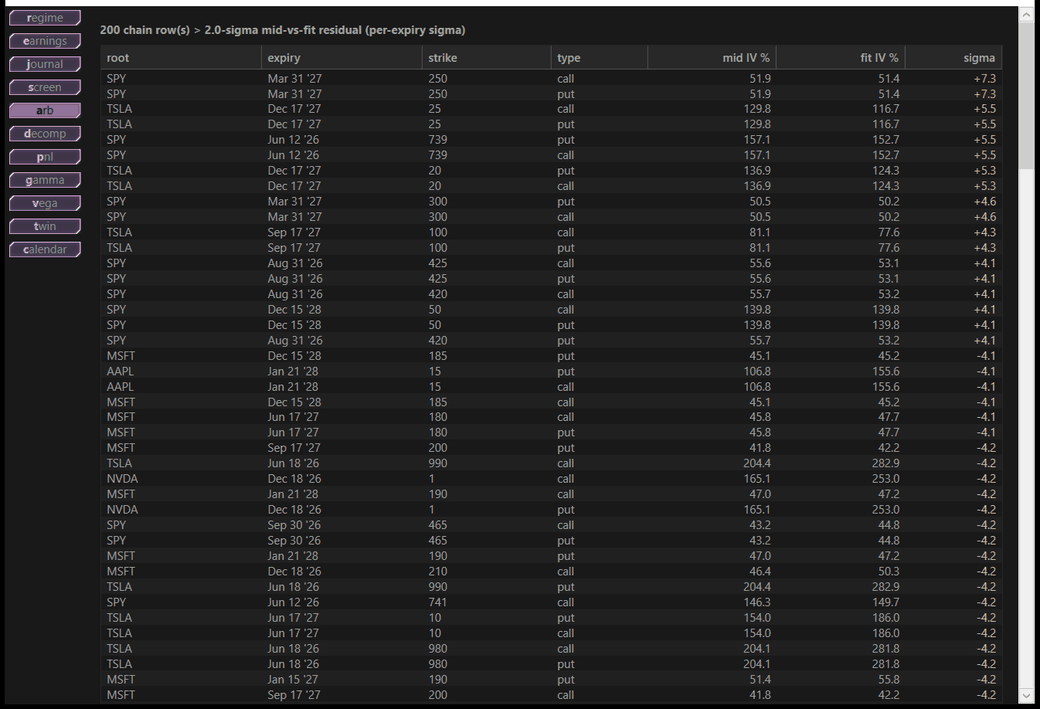
Rich / cheap strikes

Individual contracts measured against the fitted surface, so a strike trading away from its own curve is visible rather than inferred.

Pin risk

Short options sitting near strike into expiry, with the assignment and settlement consequences laid out before Friday afternoon.

Your positions, live — and yours alone

See your real book. Keep it private.

Connect to monitor

Interactive Brokers, Tastytrade and Tradier, read-only, across multiple accounts, marked live against Lavender's own Greeks.

IBKRTastytradeTradier

Bring the data you already pay for

Optionally connect your own market-data subscription — AlphaVantage, Databento or ThetaData. Not required. Lavender charges no exchange or OPRA fees; if you connect a vendor, those come with your own subscription. Your API keys stay on your machine — never uploaded, never stored by Lavender.

ThetaDataAlphaVantageDatabento

Private by design

Your contracts and position sizes never leave your machine. What you hold, and how much of it, is yours alone.

check your contracts and position sizes never leave your machine

Need a different broker or market-data provider? Email info@lavender-ts.com and tell us what you use.

Who it's for

Built for people who carry the risk.

Traders running a real book

Anyone responsible for a portfolio of options who needs to see whole-book exposure and stress it before the move, not after.

Volatility traders and researchers

Anyone who needs to read the whole surface live and watch how sensitivities move across price, vol and time.

Risk and multi-account managers

Anyone stress-testing across several books who needs to find the worst case, weigh the probabilities, and watch the book evolve.

Self-directed traders who want the real thing

Professional analytics behind every contract, alongside the brokerage you already use.

Pricing & trial

Start free. Then one flat price per seat.

Seven days, full access, nothing held back. Terminal opens on a sample book the moment you sign in — you can judge the analytics before connecting a broker or a data subscription.

7-day free trial

$390 / seat / month

Month-to-month, cancel any time · Windows 10 / Server 2016 or later


  • Whole-book risk grid, hedge recommender, and multi-broker rollup
  • 441-cell scenario matrix, crisis packs, and Monte Carlo VaR/CVaR
  • 3D volatility surface, P&L attribution over 30 days, and risk as-of 1 / 5 / 30 days
  • Greeks through third order across ~6,000 underlyings — equities, ETFs and index options
  • Connect IBKR, Tastytrade or Tradier to mark your live book

Payment method required · no charge if you cancel before it ends.

For the quant you work with

Working with an analyst?

The same engine ships as a local REST API. Your analyst builds against exactly the numbers on your screen — so when the backtest disagrees with the book, the answer is never "different vendor."

Enterprise

Running a desk?

Terminal seats for your traders, Gateway for the people building behind them, and the option to run the engine on your own inputs inside your own environment. Tell us how your desk is set up.

Not ready to install anything?

Run the engine before you install anything.

Run /surf, /skew, /term and /greeks on any listed ticker in Lavender Discord. 100 commands a day, no payment method.

Independently computed option Greeks for traders, developers and researchers. One engine behind Terminal, Gateway and Discord.


© 2026 Lavender Trading Solutions LLC · 30 N. Gould Street, Ste. 64595, Sheridan, WY 82801
Lavender Terminal is an analytics tool and does not provide investment advice.